

We’re not just selling sustainable ingredients. We’re delivering specifications that match or exceed synthetic benchmarks.
Indigoidine is produced via precision fermentation—a controlled bioprocess that delivers pharmaceutical-grade consistency. Here’s what sets it apart from both natural extracts and synthetic alternatives:
- Thermal stability: Maintains >95% color intensity at 95°C for 30 minutes (vs. 40-70% retention for anthocyanins). Enables standard food processing without formulation changes.
- pH tolerance: Stable color across pH 3-9 range with minimal hue shift (<5 ΔE units). Critical for applications from beverages (pH 2.5-4) to personal care (pH 5-8).
- Light fastness: Grade 6-7 under ISO 105-B02 testing (equivalent to high-quality synthetics). Solves shelf display and packaging transparency challenges.
- Batch consistency: CoA color strength variation <3% RSD (relative standard deviation). Enables automation of dosing without constant QC adjustments.
- Solubility: Water-dispersible formulations available, plus oil-soluble variants under development. No additional solubilizers or emulsifiers required in most applications.
- Safety profile: Non-toxic, non-allergenic, produced without hazardous intermediates. Ames-negative in genotoxicity screening. Clean regulatory pathway with testing underway for CAP approval.
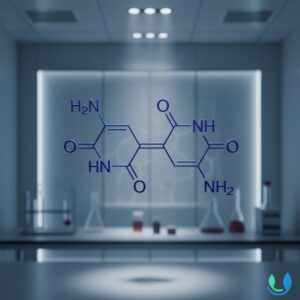
Molecular structure: Indigoidine (C₁₀H₈N₄O₄) is a natural aza-quinone first isolated from bacteria in 1893, now produced via non-ribosomal peptide synthetase pathways in engineered organisms.
This isn’t incremental improvement. It’s category redefinition.